


Personal Injury Verdict and Settlement News
Real verdicts. Real outcomes. Follow the trial results that plaintiff attorneys are talking about.



Search Verdict News
State Verdict News
Verdict Case Types
- Auto Accident 6
- Auto vs Pedestrian 3
- Birth Injury 1
- Commercial Trucking Crash 11
- Construction Accident 1
- Dog Bite 1
- DUI/DWI Injury Accident 1
- Intentional Tort 1
- Medical Malpractice 15
- Nursing Home Negligence 3
- Premises Liability 8
- Product Liability 6
- Sexual Assault 1
- Slip and Fall 4
- Toxic Tort 3
- Workplace Accident 2
- Workplace Death 3
- Wrongful Death 12
Member Search
Latest Featured Members
-
 VIEW PROFILE
Featured Member
Connor Plant - CO
-
 VIEW PROFILE
Featured Member
Jason Alleman - CO
-
 VIEW PROFILE
Featured Member
Chad Hemmat - CO
-
 VIEW PROFILE
Featured Member
Cameron Hunter - CO
-
 VIEW PROFILE
Featured Member
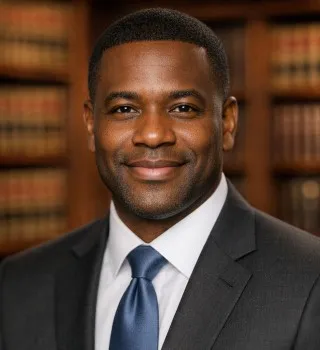
Jerome Howard - AL
-
 VIEW PROFILE
Featured Member
Helen Cho - AZ
-
 VIEW PROFILE
Featured Member
Karen Carter - CT
-
 VIEW PROFILE
Featured Member
Nicholas Thomas - CT
-
 VIEW PROFILE
Featured Member
Alice Chang - FL
-
 VIEW PROFILE
Featured Member
Sanjay Shah - GA
-
 VIEW PROFILE
Featured Member
Edward Clark - HI
-
 VIEW PROFILE
Featured Member
Siddharth Mukherjee - HI
-
 VIEW PROFILE
Featured Member
Raymond Choi - ID
-
 VIEW PROFILE
Featured Member
Ryan Campbell - IN
-
 VIEW PROFILE
Featured Member
David Russell - IA
-
 VIEW PROFILE
Featured Member
Danielle Clark - KY
-
 VIEW PROFILE
Featured Member
Andrea Tran - LA
-
 VIEW PROFILE
Featured Member
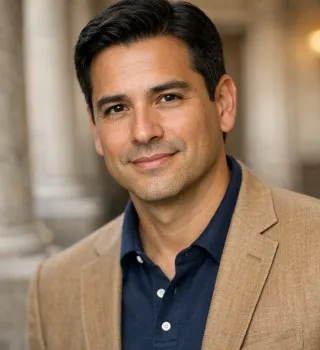
Jose Mendoza - ME
-
 VIEW PROFILE
Featured Member
Samantha Bennett - MD
-
 VIEW PROFILE
Featured Member
Curtis Davis - MA
-
 VIEW PROFILE
Featured Member
Deepak Desai - MS
-
 VIEW PROFILE
Featured Member
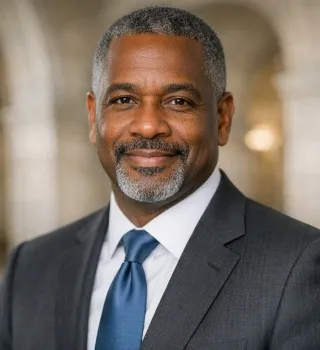
Clarence Bennett - MT
-
 VIEW PROFILE
Featured Member
Nisha Malhotra - NV
-
 VIEW PROFILE
Featured Member
Jacob Peterson - NV
-
 VIEW PROFILE
Featured Member
Katherine Phillips - NH
-
 VIEW PROFILE
Featured Member
Dennis Burke - NJ
-
 VIEW PROFILE
Featured Member
Emma Coleman - NJ
-
 VIEW PROFILE
Featured Member
Dennis Burns - NM
-
 VIEW PROFILE
Featured Member
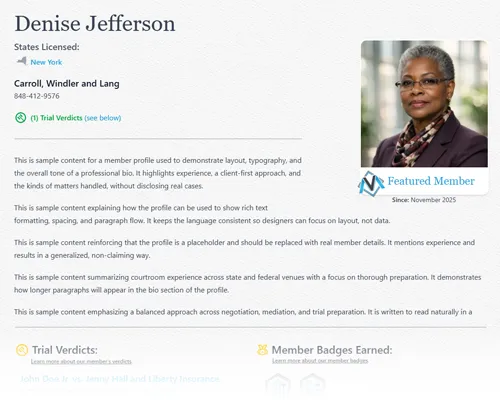
Denise Jefferson - NY
-
 VIEW PROFILE
Featured Member
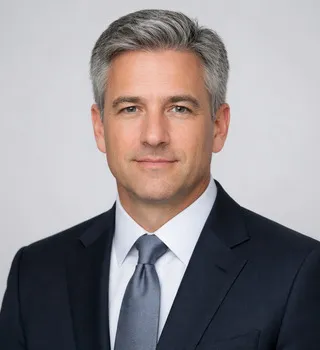
Daniel Watson - NY
-
 VIEW PROFILE
Featured Member
Sandra Scott - NC
-
 VIEW PROFILE
Featured Member
Jose Diaz - NC
-
 VIEW PROFILE
Featured Member
Amy Williams - ND
-
 VIEW PROFILE
Featured Member
Sunita Bose - OR
-
 VIEW PROFILE
Featured Member
Charles Phillips - OR
-
 VIEW PROFILE
Featured Member
Stephen Mitchell - PA
-
 VIEW PROFILE
Featured Member
Ruben Garcia - RI
-
 VIEW PROFILE
Featured Member
Jack Warren - SC
-
 VIEW PROFILE
Featured Member
Gerald Hall - SD
-
 VIEW PROFILE
Featured Member
Keith Wood - TX
-
 VIEW PROFILE
Featured Member
Derek Lu - UT
-
 VIEW PROFILE
Featured Member
Luis Sandoval - UT
-
 VIEW PROFILE
Featured Member
Sophia Lewis - VT
-
 VIEW PROFILE
Featured Member
Ann Cooper - VA
-
 VIEW PROFILE
Featured Member
Raymond Warren - WA
-
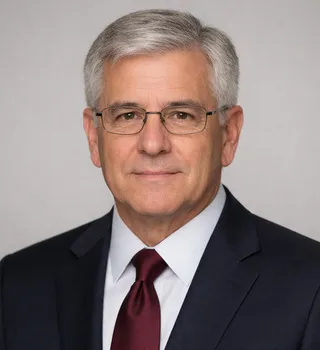 VIEW PROFILE
Featured Member
Joseph Crawford - WI
-
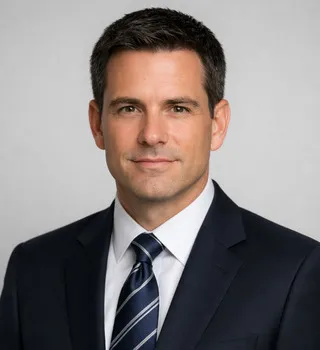 VIEW PROFILE
Featured Member
Gregory Peterson - WY
-
 VIEW PROFILE
Featured Member
Victoria King - TN, IA
-
 VIEW PROFILE
Featured Member
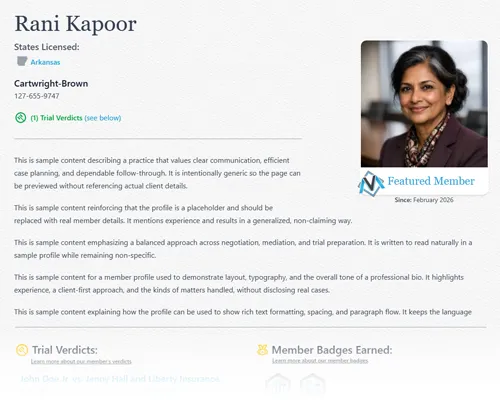
Rani Kapoor - AR
-
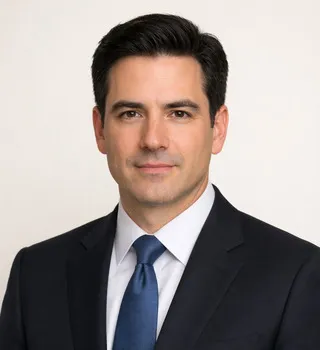 VIEW PROFILE
Featured Member
Ronald Carter - AL
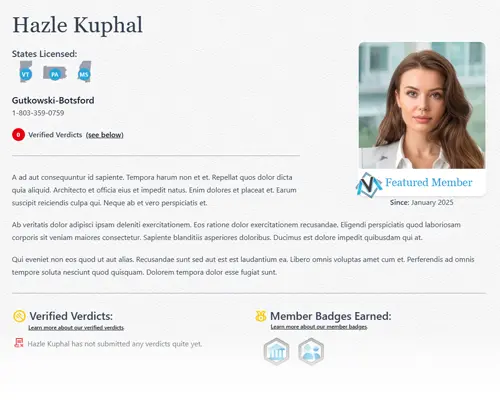




Plaintiff trial attorneys. Join now for free!
ShowcaseYour Experience
Major Verdict gives you a free public profile to showcase your hard-earned trial verdicts and notable settlements. Let your results speak for themselves to potential clients and peers nationwide. You control what you share, when you edit, and how your public record is presented.